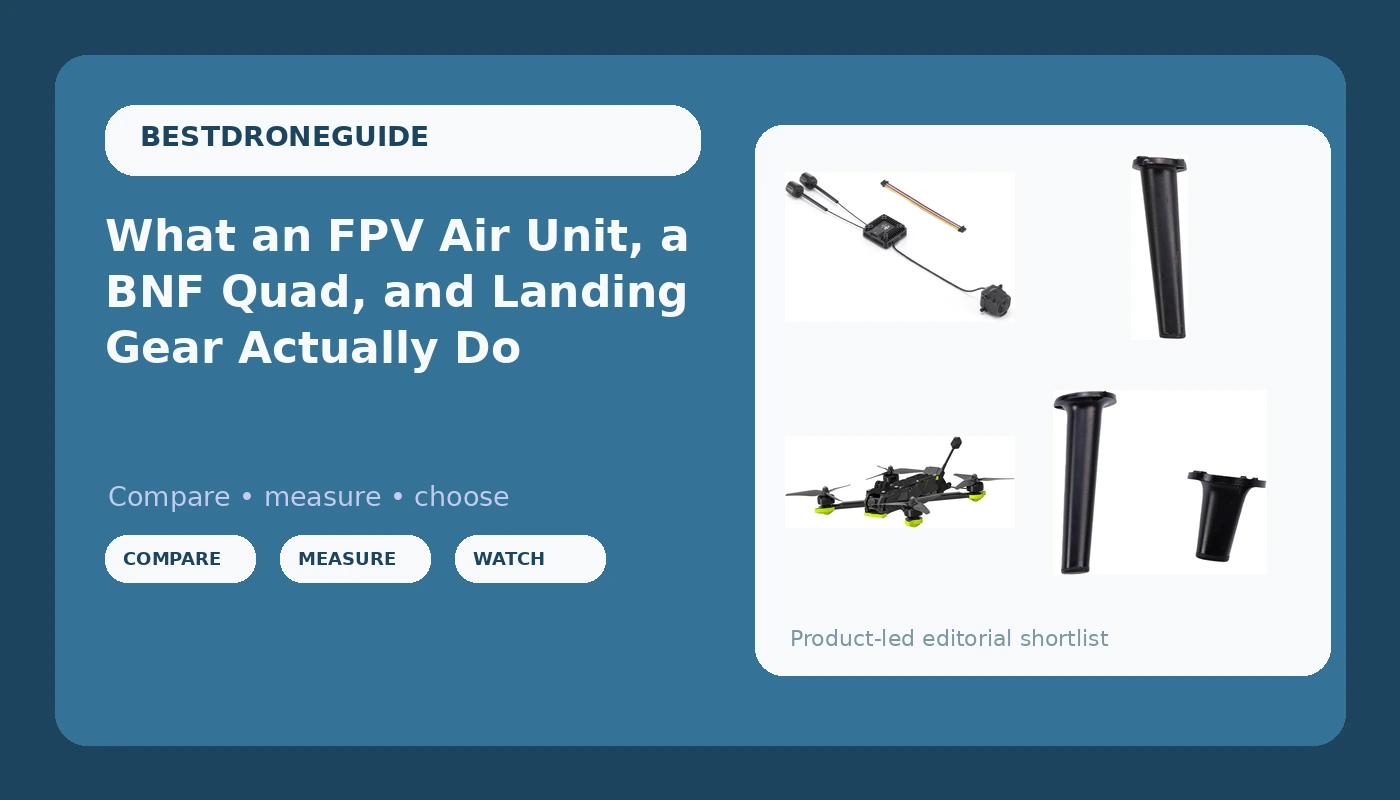
Four listings, three completely different jobs, and one very common mistake. That is what happens when an FPV air unit and landing gear end up in the same shopping session. One of these products is the camera and radio link that turns a bare frame into a flying aircraft. One is a complete bind-and-fly quad that arrives waiting for a radio and a battery. Two are molded replacement parts for an Autel airframe, and those two are not interchangeable with each other. Pick the wrong category and the part will not bolt to your aircraft at all. Pick the wrong ecosystem and the electronics will not talk to your goggles or your radio.
Related: How to Read Drone Spec Sheets Without Getting Fooled →
Quick answer
The DJI O4 Air Unit Pro is a digital transmission and camera module for an FPV build, not a complete aircraft. The iFlight Nazgul ECO XL5 V1.1 is a complete analog 6S bind-and-fly quad that ships with a TBS Crossfire Nano receiver installed. The two Autel items are replacement landing gear: one is a front-left leg for the EVO 2 640T V2 and V3, and the other is a front and rear foot set. Match the airframe, the version, and the position before you order, because none of these is a universal fit.
4 useful options
| Model | Best fit | What stands out |
|---|---|---|
| DJI O4 Air Unit Pro for FPV Drone, Digital Transmission System, 15ms Low Latency, 15km Max Range, 4K/120fps Video Recording, 1080p/100fps Live View, 155° FOV, 1/1.3-inch CMOS Sensor | Builders who want digital video and control in one module | Published specs list 15ms latency, 15km max range, 4K/120fps recording, and a 1/1.3-inch CMOS sensor |
| iFlight Nazgul ECO XL5 V1.1 Analog 6S Drone BNF TBS Crossfire NANO RX | Pilots who want a ready-built analog 5-inch class quad | Bind-and-fly configuration with a TBS Crossfire Nano receiver and 6S power |
| Original [Front Left] Landing Gear for Autel EVO 2 640T V2/V3 Drone Replacement Stand with Rubber Arm Leg for EVO 2 640T V2 / V3 UAV Repair Part - New | Replacing one damaged front-left leg | Position-specific replacement leg with the rubber arm leg included |
| Landing Feet Front Rear, Compatible For Autel | Refreshing worn contact points at both ends | Front and rear feet supplied together for Autel airframes |
The video link: DJI O4 Air Unit Pro for FPV Drone
An air unit is a component, and that is the part people miss. You still need a frame, motors, ESCs, a flight controller, a radio, goggles, and batteries. What the unit decides is the quality of the image you see while flying and the link that keeps the aircraft connected to your hands. Sensor size matters more than a megapixel number here: the listed 1/1.3-inch CMOS is a genuinely larger light-gathering surface than what small cameras use, and that shows up in shadow detail on an overcast shoot day. Range figures like 15km are line-of-sight numbers in clean radio conditions, so treat them as a ceiling, not a promise. Latency is the spec that changes how the aircraft feels, and 15ms is in the range where stick inputs stop feeling delayed.
The ready-to-bind quad: iFlight Nazgul ECO XL5 V1.1 Analog 6S Drone BNF TBS Crossfire NANO RX
Analog video is a deliberate trade. You give up the crisp image a digital link produces and you take on a little more visual noise, but analog gear is simpler, cheaper to repair, and does not care which goggles brand you own as long as they are analog. The Crossfire Nano receiver is the detail to check first: if your radio does not speak Crossfire, this aircraft is not ready to fly for you, no matter what the listing says. If it does, a bind-and-fly quad is the shortest path from box to first flight. Six-cell power means more punch and more weight, and it also means your battery budget just went up, because 6S packs cost more than 4S and you will want at least three of them.
The front-left replacement: Original [Front Left] Landing Gear for Autel EVO 2 640T V2/V3
Landing gear exists to be the part that breaks instead of the part that matters. The 640T is a thermal inspection platform, the kind of aircraft that gets carried through gates, set down on gravel, and folded into a case by someone wearing gloves. That life punishes legs and feet first. A front-left leg will not substitute for a front-right or a rear leg, and V2 and V3 airframes are listed as separate fits for a reason. Before ordering, look at the damaged leg on your aircraft and confirm which corner it is, then confirm the airframe generation. This is a repair part, so the only thing that matters is whether it matches what you are replacing.
The full foot set: Landing Feet Front Rear, Compatible For Autel
Feet are the part nobody inspects until a landing goes wrong. The rubber pads are what grip a slick surface and what absorb the small impacts of a normal day, and they flatten, harden, and split over time. Replacing feet instead of a whole leg is the cheaper repair when the damage is only at the contact point. Check the listing against your specific airframe before ordering, since compatibility language on generic repair parts is deliberately broad, and a foot that fits one Autel model may not fit another. Buy a spare set while you are at it. Shipping time on a small molded part is exactly the kind of delay that grounds an aircraft for a week.
Prices and availability may change. Product images, names, and retailer links are matched to verified listings. No current price, rating, stock status, or measured result is stated here without current evidence.
How a digital air unit changes an FPV build
A digital air unit merges three jobs that used to be separate: the camera, the video transmitter, and the control link. That consolidation is why digital builds are cleaner and why the module is the single biggest decision in the aircraft. Everything downstream has to support it. Your frame needs room for the unit and its antenna mounting. Your flight controller needs to talk to it. Your goggles need to be compatible with the system it uses. Your radio needs a receiver that works with the same ecosystem.
The specs worth reading carefully are latency, live view resolution, and recording resolution, because they answer different questions. Latency tells you how the aircraft will feel. Live view resolution tells you how much you can actually see while flying. Recording resolution tells you what you can hand a client afterward. The listed 1080p/100fps live view and 4K/120fps recording on the DJI O4 Air Unit Pro sit at the high end of what FPV modules currently advertise, and the 155° field of view is wide enough to catch a full frame without a fisheye look in the final edit.
The number that gets oversold is range. Fifteen kilometers is a clean-air, line-of-sight figure. Fly behind a building, drop below a ridge line, or fly in a city with competing 2.4GHz and 5.8GHz traffic, and your usable distance shrinks fast. Heat matters too. Electronics in a sealed airframe on a 110-degree day are running in an oven, and a module that works flawlessly in spring can start behaving differently in July. Plan your flights around that, not around the spec sheet.
Why landing gear is the cheapest insurance on a camera drone
Landing gear does two things: it holds the aircraft off the ground so the gimbal and camera never touch anything, and it takes the abuse of every imperfect landing. On an inspection platform, the gear is also the part that catches on a case, a car door, or a fence while you are carrying the aircraft with one hand and a controller in the other.
Replacement gear is one of the few drone purchases where being specific saves you money. Position-specific parts exist because legs are shaped differently on each corner, and generation-specific parts exist because manufacturers revise airframes between versions. The front-left leg and the front-rear foot set in this group are two different levels of repair: one replaces a structural leg with its rubber arm, the other refreshes the contact surfaces. Knowing which level of damage you have is the whole decision.
The rest is prevention. Inspect the gear after any hard landing, not just a crash. Look for cracks at the attachment point, not only at the visible leg. A hairline crack at the mount will fail at the worst possible moment, usually on the landing that matters. And keep the old part in a drawer even after you replace it, because a scuffed spare is better than a grounded aircraft.
- Decide what you are buying: a component, a complete aircraft, or a repair part. These four listings cover all three, and they are not substitutes for each other.
- Confirm the platform before anything else, including the generation and, for parts, the exact position on the airframe.
- Match the electronics to the ecosystem you already own. A digital air unit needs compatible goggles, and a bind-and-fly quad with a Crossfire receiver needs a Crossfire-capable radio.
- Budget the complete system, not the listing. Batteries, charger, radio, goggles, props, and spare parts are part of the real cost of a 6S FPV quad.
- Compare the part to your aircraft before ordering, and keep the removed part as a reference until the replacement is confirmed to fit.
Before you order
- Photograph the damaged part on your aircraft and check the photo against the listing image before checkout.
- Confirm the airframe version. A V2 part and a V3 part can look similar and fit differently.
- Check which corner or end you are replacing. Front-left is not front-right, and a leg is not a foot.
- Verify receiver compatibility if you are buying a bind-and-fly quad. The radio you own decides whether it flies this weekend.
- Plan for heat and battery life. Buy extra packs, store them at partial charge, and do not leave them in a hot car between flights.
Which option should you choose?
Choose the DJI O4 Air Unit Pro for FPV Drone, Digital Transmission System, 15ms Low Latency, 15km Max Range, 4K/120fps Video Recording, 1080p/100fps Live View, 155° FOV, 1/1.3-inch CMOS Sensor when you are building or upgrading an FPV aircraft and want digital video, digital control, and onboard recording in one module. Choose the iFlight Nazgul ECO XL5 V1.1 Analog 6S Drone BNF TBS Crossfire NANO RX when you want a finished analog quad, you fly a Crossfire-compatible radio, and you would rather spend your evenings flying than soldering. Choose the Original [Front Left] Landing Gear for Autel EVO 2 640T V2/V3 Drone Replacement Stand with Rubber Arm Leg for EVO 2 640T V2 / V3 UAV Repair Part - New when a front-left leg on an EVO 2 640T V2 or V3 is cracked or broken. Choose the Landing Feet Front Rear, Compatible For Autel when the legs are fine and only the contact feet are worn.
The specifications above are the ones the sellers publish. They are not independent test results, and real performance changes with wind, heat, altitude, and how crowded the radio band is where you fly. Check the current listing, the compatibility notes, and the fitment details for your own aircraft before you commit.
The bottom line
These four listings only look related because they all belong to the drone hobby. In practice they serve three separate jobs, and the buyer who understands that stops wasting money. A digital air unit is the brain and eye of a build you assemble yourself. A bind-and-fly 6S quad is the shortcut for someone who wants to fly now and has the right radio. The two Autel parts are cheap repairs that protect an expensive camera platform from a problem that costs far more than the part. Buy the category that matches your actual problem, confirm the fit and the ecosystem, and keep a spare of the parts that touch the ground.