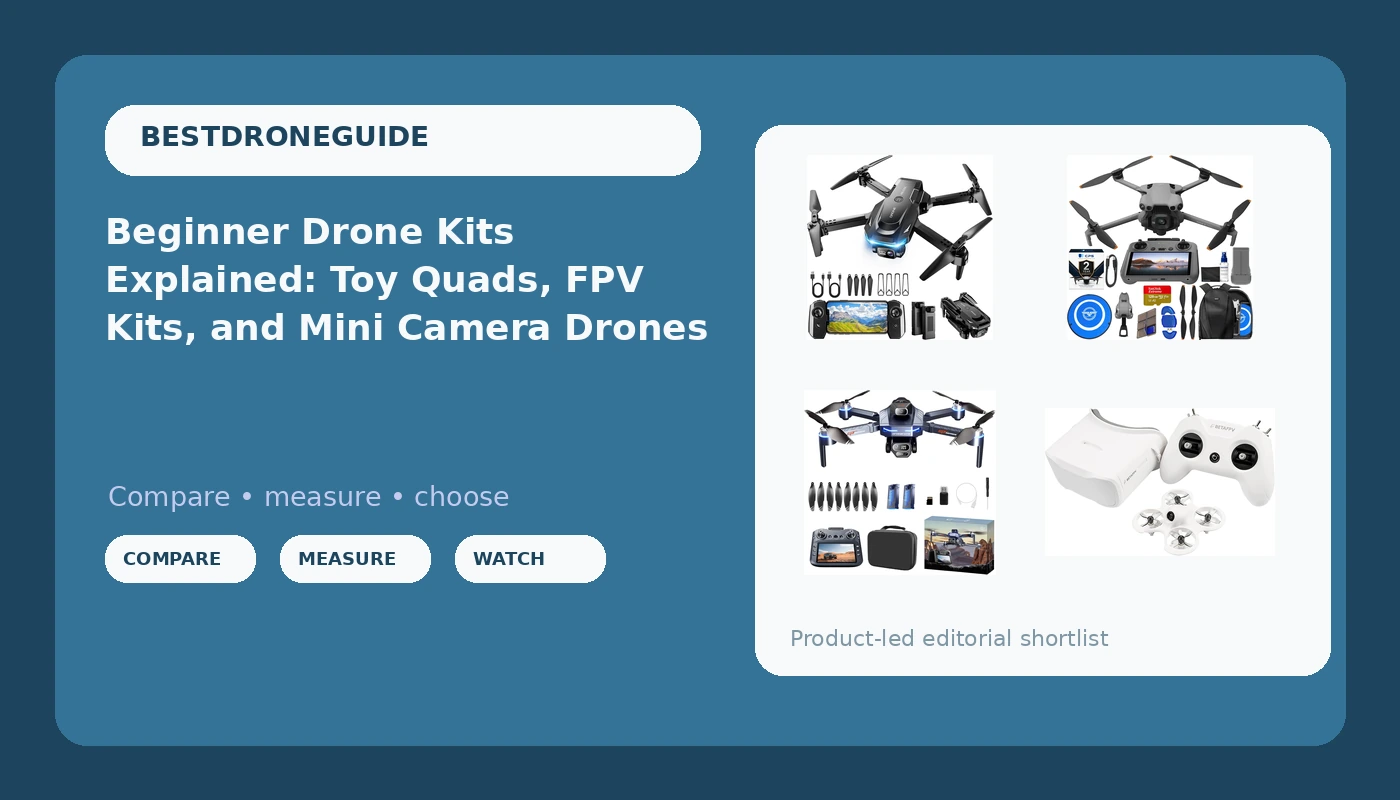
If you are shopping for a first drone, the listings blur together fast. Beginner drone kits advertise 1080P cameras, FPV video, obstacle avoidance, and folding arms, and the prices swing from pocket money to more than a month of rent. The names promise the same experience, and the spec sheets contradict each other the moment you put them side by side. This explainer takes four real listings, from a simple foldable camera quad to a full FPV goggle kit and a mini drone with a screen controller, and separates what each one is actually built to do from what the marketing implies.
Related: How Drone Flight Time Claims Survive Real Heat →
Quick answer
There is no single right first drone, because the correct one depends on what you want out of flying. If you want to learn manual FPV flight, an RTF kit that includes goggles and simulator support is the shortest path. If you want smooth aerial video with the least effort, a GPS mini drone with a screen controller and omnidirectional vision sensing does more of the work for you. If you want to find out whether you enjoy flying at all before spending real money, a low-cost foldable camera quad answers that question with the least risk.
Four useful options
| Model | Best fit | What stands out |
|---|---|---|
| Drone with 1080P Camera - Foldable Remote Control RC Quadcopter FPV Drone | Testing the hobby on a small budget | Foldable frame, 1080P camera, and an FPV video feed in one low-cost kit |
| FPV Drone with HD Camera for Adults, RC Drones with 5 Inch LCD Screen on Controller | One aircraft for indoors and the backyard | Listed under 250g, brushless motors, optical flow positioning, two batteries and a case in the box |
| BETAFPV Cetus FPV Kit Brushed Racing Drone RTF Kit for FPV Beginners | Learning to fly with goggles | Complete ready-to-fly kit with VR02 FPV goggles, height hold, and FPV simulator support |
| DJI Mini 5 Pro Drone with RC 2 2 (Remote Controller w/ Screen) | Effortless, polished aerial video | Screen controller, 4K HDR video, omnidirectional vision sensing, and a bundle with memory card and landing pad |
The low-stakes first quad: Drone with 1080P Camera - Foldable Remote Control RC Quadcopter FPV Drone
What the listing does not claim matters as much as what it does. There is no GPS return-to-home, no obstacle sensing, and no brushless motor spec mentioned in the name, so plan to fly this one line of sight, in calm air, over open ground. Cameras at this end of the market are fine for social clips and for learning how to frame a shot, not for paid work. What you get in return is a very low entry cost and an aircraft you will not grieve over if you clip a branch. Buy it to answer one question: will you actually fly it more than twice?
The sub-250g all-rounder: FPV Drone with HD Camera for Adults, RC Drones with 5 Inch LCD Screen on Controller
Two batteries in the box is the detail I would weigh heaviest. A single battery means twenty minutes of flying followed by an hour of waiting, which is how drones end up in closets. Brushless motors are the other meaningful upgrade over the cheapest tier: fewer replacements, less noise, and better behaviour in a breeze. Be clear about what optical flow positioning is, though. It holds a hover by watching the ground below, which works well indoors and low to the surface. It is not GPS, and the listing does not mention GPS, so do not expect automatic return-to-home on a lost signal.
The real FPV starter kit: BETAFPV Cetus FPV Kit Brushed Racing Drone RTF Kit for FPV Beginners
Flying through goggles is a different skill from flying a camera drone, and it is the one skill that transfers to everything else in FPV. The trade-off is maintenance. Brushed motors are consumable parts, so budget for replacements and spare props, and expect to swap them as you learn. The simulator support matters more than it sounds: an hour in a simulator costs nothing and saves airframes. One boundary worth stating: this is a learn-to-fly kit, not a racing build. If your goal is competitive racing, you are shopping in a different category with different hardware, and this kit is the on-ramp rather than the destination.
The effortless aerial video option: DJI Mini 5 Pro Drone with RC 2 2 (Remote Controller w/ Screen)
The 36 minute flight time in the listing name is a manufacturer figure, and you should read it the way you read any flight time claim: as a ceiling measured under friendly conditions, not a promise. Heat, wind, and aggressive manoeuvring all eat into it, and in a Phoenix summer I plan on noticeably less than the number on the box. The screen controller is the underrated part of this bundle, because it removes the phone pairing step that breaks so many flying sessions. Omnidirectional vision sensing is a safety net, not a pilot. It helps, and it will not save you from flying backwards into a wall at speed.
Prices and availability may change. Product images, names, and retailer links are matched to verified listings. No current price, rating, stock status, or measured result is stated here without current evidence.
What the spec sheets leave out
The numbers that sell drones are the numbers that are easiest to inflate. Flight time is measured in ideal conditions with a fresh battery, no wind, and gentle hovering, so treat every claim as a starting point and subtract for real weather. Camera quality is more than a resolution figure: a 1080P camera on a small sensor and a 4K camera on a small sensor can both struggle in low light, and no resolution number tells you how the footage handles a bright sky and a dark roofline in the same frame. Then there is the part nobody advertises, which is battery cycle life. Batteries are the real running cost of this hobby. Heat degrades them, storage at full charge degrades them, and a battery that swells is a battery you retire rather than charge again.
The app and firmware experience belongs in your decision too. A drone that requires an account, a login, and a download before it will fly is a drone that can strand you at a job site or a trailhead with a dead session. If the aircraft in front of you relies on a phone, read the recent user reports about that app before you buy, not just the aircraft reviews.
How to choose in five steps
- Decide what you want to learn first: manual FPV flight, or smooth automated video. The two goals point at different kits.
- Match the weight class to where you will fly. Sub-250g aircraft are the easier category to live with for casual flying and indoor practice.
- Count the batteries in the box. Two batteries roughly doubles a session, and a single battery kit usually becomes a shelf ornament.
- Check which flight assists are actually listed: GPS return-to-home, optical flow positioning, vision sensing, and height hold do different jobs, and they are not interchangeable.
- Budget for the consumables before you commit: spare props, spare motors if the aircraft uses brushed motors, extra batteries, and a memory card if one is not included.
Before you check out
- Buy the kit with two batteries over the kit with one, even if the second battery costs extra.
- Add spare props at the same time as the drone. Shipping a two dollar part alone later costs more than the part.
- Register and check local rules before the first flight if your aircraft is above the sub-250g threshold.
- Store batteries at partial charge, not full, and never charge a swollen pack.
- Learn the camera settings on the ground, so your first flight is flying practice rather than menu practice.
- Check that the included case actually fits the aircraft with the gimbal guard attached, since that mismatch is a common complaint.
Which option should you choose?
Choose the Drone with 1080P Camera - Foldable Remote Control RC Quadcopter FPV Drone when you want the cheapest possible answer to whether this hobby sticks, and you are flying line of sight in calm, open space. Choose the FPV Drone with HD Camera for Adults, RC Drones with 5 Inch LCD Screen on Controller when you want one under-250g aircraft with a screen controller, brushless motors, two batteries, and a case, for indoor practice and backyard video. Choose the BETAFPV Cetus FPV Kit when goggles-on FPV flight is the actual goal and you want a ready-to-fly kit plus simulator practice. Choose the DJI Mini 5 Pro Drone with RC 2 bundle when your priority is clean aerial video with minimal setup, and the budget is not the deciding factor.
One caveat applies to all four. Nothing here is a statement about measured performance, image quality, or endurance in your conditions. Those depend on your weather, your batteries, and your flying style, and the honest way to judge any of these aircraft is to read the current listing details and the recent buyer reports on the listing itself.
The bottom line
The cheapest quad in this group is a low-risk experiment, the sub-250g kit is the most complete beginner package on paper, the FPV kit is the only one that teaches goggle flight, and the mini drone bundle is the one that gets out of your way and produces usable video. Pick the aircraft that matches the flying you will actually do in the next three months, not the one with the largest number in its name. Then buy spare batteries and props with it, because that is what keeps it in the air.