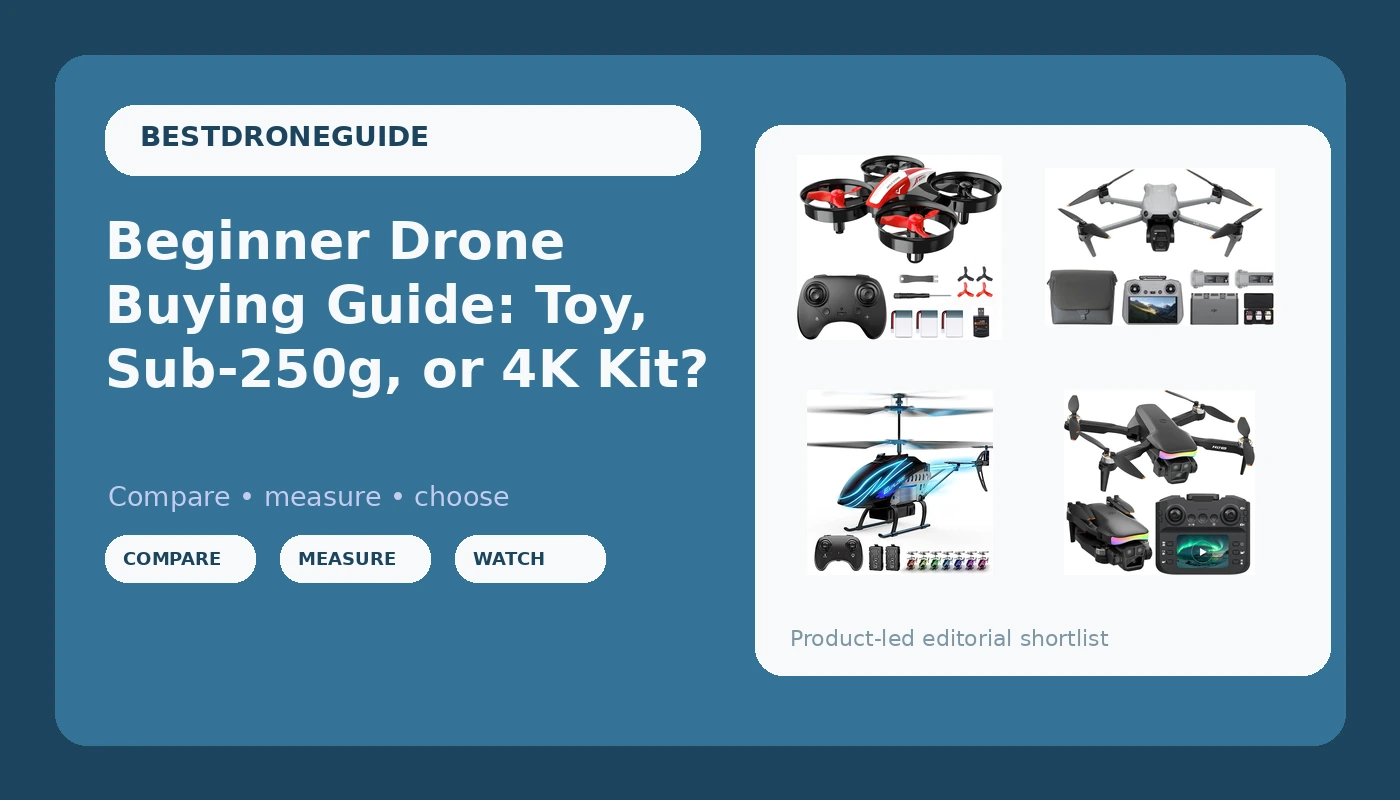
Most people shopping for a first drone are actually shopping for two different things at once: a toy that survives a living room, and a camera platform that produces footage worth keeping. This beginner drone buying guide sorts four very different aircraft by who flies them and where. The distance between an indoor nano quadcopter and a 4K Fly More Combo kit is not really a quality gap, it is a purpose gap, and buying at the wrong end of it is the most common expensive mistake a new pilot makes. Weight, control layout, and whether a camera is part of the point matter more than any single number on a spec sheet.
Related: Sub-250g Drone Battery Care in Extreme Heat →
Quick answer
Match the aircraft to the pilot and the airspace before you match it to a budget. The Holy Stone HS210 mini drone is built for indoor first flights, with auto hovering, headless mode, and three batteries in the box. The BUSSGO RC Helicopter is a helicopter for kids rather than a quadcopter, so it teaches a different control feel. The sub-250g camera drone with the screen remote controller is the one that adds camera flights for adults and teens without needing a phone. The DJI Air 3S Fly More Combo is the only 4K model in this group and the only one aimed at enthusiasts and working shooters. Fit here depends on weight class, control layout, and whether you actually want footage, not on which one sounds most impressive.
Four useful options
| Model | Best fit | What stands out |
|---|---|---|
| Holy Stone Mini Drone for Kids and Beginners RC Nano Quadcopter | Indoor first flights for kids | Nano quadcopter with auto hovering, headless mode, 3D flips, and three batteries |
| BUSSGO RC Helicopter, Remote Control Helicopter for Kids | Kids who asked for a helicopter | Single-rotor helicopter layout instead of a quadcopter |
| Drone with Camera, FPV Drone with Screen Remote Controller | Camera flights without a phone | Screen controller, brushless motors, foldable frame, one key start, sub-250g |
| DJI Air 3S Fly More Combo (RC 2 Screen Remote Controller), 4K Drone | Enthusiasts and working shooters | 4K drone sold as a bundled Fly More Combo with the RC 2 screen controller |
Indoor starter: Holy Stone HS210 Mini Drone
This is toy-class hardware, and that is the point. There is no GPS position hold, no gimbal, and no camera worth grading, so the aircraft is best flown indoors or in genuinely still air. What it does teach is the thing beginners need most: throttle discipline and the reflex to cut power when the wall is closer than it looked. Headless mode removes the mental rotation problem that makes a first flight frustrating for a child, and auto hovering means the drone is not silently drifting while the pilot thinks. The three batteries matter more than any spec here, because a nano quadcopter flight is short and a single battery turns a 15-minute session into a five-minute one.
Helicopter alternative: BUSSGO RC Helicopter
A helicopter is not a worse drone, it is a different machine, and the distinction matters when a child has specifically asked for one. Single-rotor models generally demand smoother collective and cyclic style input than a quadcopter, which is a real skill but also a real frustration curve for a young pilot. It is also not a camera platform in any meaningful sense, so if footage is part of the plan, this is the wrong branch of the tree. Treat it as a gift-category aircraft for indoor or calm-outdoor play, with adult supervision and a clear understanding that it is a toy rather than an aerial imaging tool.
Sub-250g camera drone: Drone with Camera, FPV Drone with Screen Remote Controller
Two details carry this model. The first is the screen controller: a built-in display removes the phone mount, the cable, the app install, and the account setup that derails a lot of first camera flights. The second is the weight class. A stated sub-249g figure is the threshold many regulators use to separate aircraft that need registration from those that generally do not, though the exact rules depend on where you fly and whether a camera is transmitting, so check your local requirements rather than assuming. Brushless motors are the other meaningful upgrade over the nano toys, because they handle wind and repeated sessions better than brushed motors. The manufacturer's 20-minute flight time is a claim, and claims are measured in ideal conditions. Expect less in wind, in cold, and in the heat that punishes every lithium pack.
4K aerial platform: DJI Air 3S Fly More Combo
This is the only aircraft in the group that belongs to the camera-first category, and the jump is not incremental. A stabilized gimbal, a real sensor, and a software ecosystem that receives firmware updates are what separate footage you would show a client from footage you delete. The Fly More Combo designation matters too: DJI uses it for bundled kits rather than the standalone aircraft, which is the version to buy if you would otherwise be ordering spare batteries separately, since batteries are the recurring cost in this hobby. Be realistic about the trade-offs. This aircraft is heavier than the sub-250g class, so registration and remote identification requirements are more likely to apply, and it is not a living-room toy under any circumstances. It also assumes you will actually learn to fly it, because a camera this good on an airframe you cannot control produces nothing but soft footage of the ground.
Prices and availability may change. Product images, names, and retailer links are matched to verified listings. No current price, rating, stock status, or measured result is stated here without current evidence.
What the spec sheet leaves out
Flight time is the number buyers trust most and should trust least. A stated 20 minutes is a lab figure produced in controlled air with a fresh pack, and it is closer to a ceiling than an average. Wind forces the motors to work harder, cold reduces the usable capacity of a lithium pack, and heat degrades it permanently over time. If you plan around roughly two thirds of the advertised number, you will plan realistically and land with margin instead of landing at the edge of the battery.
Camera specifications deserve the same skepticism. Megapixel counts and interpolated resolutions sell drones, but sensor size and stabilization quality determine whether the image holds up. A larger sensor with fewer pixels generally beats a tiny sensor with more of them, particularly in low light, and no amount of resolution fixes a jittery gimbal or a rolling shutter. If you are comparing two camera drones, look at the sensor and the gimbal before the pixel count.
The app is part of the product. Firmware updates, flight logs, geofencing, and video transfer all run through software, and an aircraft with a neglected app becomes an aircraft with outdated limits and awkward workflows. A controller with a built-in screen, like the ones on two of the models here, reduces that dependency for basic flying, but it does not eliminate it entirely.
Matching the aircraft to the pilot and the airspace
The most common mismatch is not budget, it is weight class. Sub-250g aircraft exist because many aviation authorities treat them differently from heavier models, often with lighter registration obligations, which makes them the practical entry point for casual flyers who want camera footage without paperwork. That threshold is not universal, and a camera-equipped drone may trigger additional rules in some places, so confirm the requirements where you actually fly rather than relying on the marketing weight.
The second mismatch is environment. Indoor nano quadcopters and toy helicopters belong in a living room or a gym, away from people, pets, and anything breakable. Camera drones belong outdoors in open space with a clear line of sight, away from airports, crowds, emergency scenes, and private property you do not have permission to overfly. Line of sight means exactly that: you can see the aircraft with your own eyes, not just on a screen.
The third mismatch is the pilot's age and patience. A young child is better served by an inexpensive indoor quadcopter with assisted modes and spare batteries than by a camera drone that will spend its first flight in a tree. An adult who wants to shoot video should skip the toy stage entirely and start with something that has a gimbal, because unlearning bad habits is harder than learning good ones.
- Decide who flies it most often and how old they are.
- Decide whether you want footage or just flight time.
- Decide where it will actually fly, indoors, a backyard, or open country.
- Check the weight class and the registration rules that apply where you fly.
- Buy batteries and spare props with the aircraft rather than after the first crash.
Practical guidance before the first flight
- Read the local rules for your country and region before the maiden flight, not after.
- Charge every battery fully and label them so you can track which pack is fading.
- Calibrate the compass and set a return-to-home altitude in an open area on the first flight.
- Fly the first three sessions in low wind and in good light, and keep the aircraft within easy visual range.
- Store packs at a moderate charge level, never leave them in a hot car, and retire any pack that swells.
Which option should you choose?
Choose the Holy Stone HS210 Mini Drone when a child needs an indoor first aircraft that can bounce off furniture and still fly, and when three batteries in the box matters more than any camera. Choose the BUSSGO RC Helicopter when the request was specifically for a helicopter and the pilot wants to learn single-rotor control rather than quadcopter control. Choose the Drone with Camera, FPV Drone with Screen Remote Controller when you want camera flights as an adult or teen beginner and you would rather not tether the whole experience to a phone. Choose the DJI Air 3S Fly More Combo when you are past the novelty stage, you want 4K footage with stabilization, and you are prepared for the registration and battery costs that come with a heavier aircraft.
One caveat applies to all four. Every specification quoted here comes from the manufacturer's listing rather than from a controlled comparison, and flight time, camera quality, and durability in real conditions will differ from the label. Treat the numbers as a starting point for research, and treat the return policy as part of the purchase.
The bottom line
These four aircraft do not compete with each other, they occupy four different jobs. The nano quadcopter teaches a child to fly indoors for the price of a toy. The helicopter serves a specific request. The sub-250g camera drone is the most balanced first camera platform in the group, because it removes the phone dependency and keeps the weight class friendly. The DJI Air 3S Fly More Combo is the one that produces footage worth keeping, and it is also the one that requires the most commitment in rules, batteries, and practice. Pick the job first, and the model picks itself.